
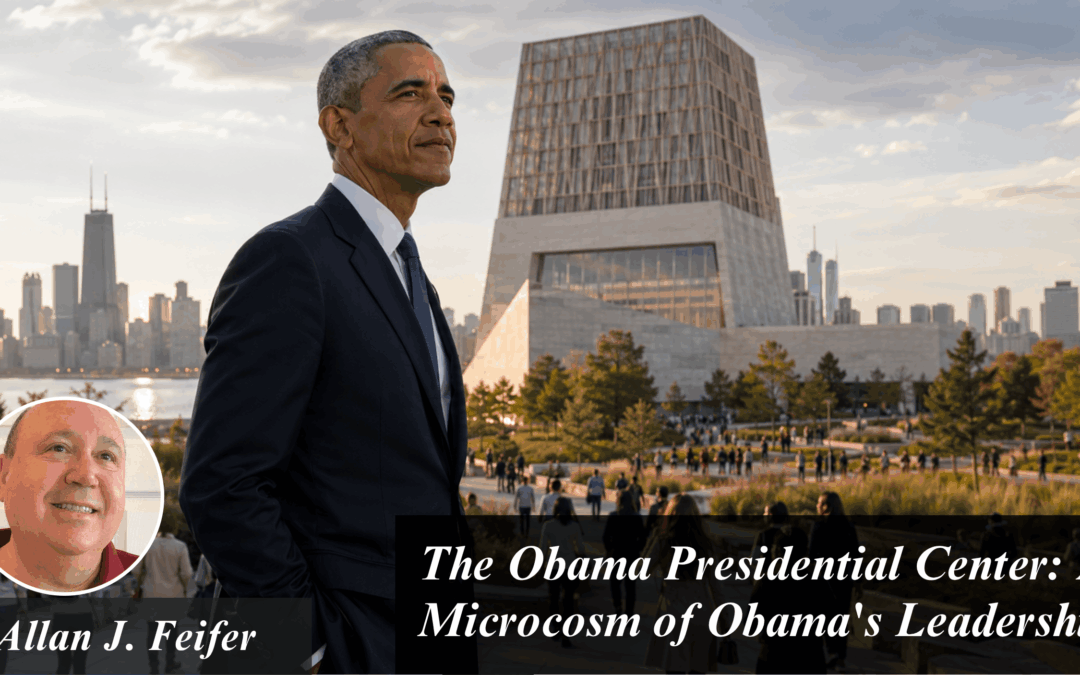
When the Obama Presidential Center was first announced, it was sold as a transformative civic investment — a cultural anchor for Chicago’s South Side, a symbol of renewal, and a legacy project for America’s 44th president. The early price tag hovered around $300 million, a number that was never realistic but politically convenient, allowing the project to launch. The project was framed as privately funded, publicly beneficial, and a model of community partnership. In reality, it was none of those things. Instead, it’s been a great reminder of just how bad Obama was as a president and a non-leader.
A decade later, the reality looks very different. The cost has ballooned to $850 million and is still climbing, even though it is ostensibly finished. Subcontractors report millions in unpaid invoices. The required $470 million endowment — meant to protect taxpayers — contains almost nothing, barely a million dollars. The general contractor has been removed. Lawsuits are underway. And the project’s construction cost alone — roughly $615 million for 400,000 square feet — translates to an astonishing $1,500 per square foot, a figure far above even elite museum standards.
Perhaps you’ve heard of “The Chicago Way.” I’ve heard it translated into: “In Chicago, graft’s not a glitch — it’s the business model.” Let’s delve a bit deeper into the Marianas Trench of everything that could go wrong, did go wrong, and how predictable it all was from day one.
To understand how we got here, you have to trace the chain of decisions from the beginning — and then follow the principle that in any serious organization, ultimate responsibility sits at the top. Of course, with Obama anointed as “The One,” the Democrats’ belief that he was their political messiah, nothing could go wrong. Right?
The Origin: A Vision Untethered From Reality
The Obama Foundation launched the project with three defining objectives:
- A politically symbolic contractor structureThe Foundation selected Lakeside Alliance, a consortium of mostly Black-owned firms, as the general contractor. This was a symbolic and politically expedient choice — but it meant the firm would lead the project without deep megaproject experience.
- Aggressive minority participation goalsThe Foundation set unusual and unrealistic targets:50% of subcontracting dollars to minority-owned firms
10% to women-owned firms
These goals are legal and common in Chicago, but at this scale, they reduce the pool of experienced firms and increase administrative complexity.
A Donor-Funded Model With No External Oversight
Because the Obama Center is not a federal presidential library, it is not subject to the Presidential Libraries Act. That means:
- No congressional review
- No NARAoversight
- No public audit requirements
The Foundation controlled the money, the contracts, and the oversight.
This structure was politically advantageous — and ultimately operationally dangerous. One could be excused for believing the structure was intentional.
The Perfect Storm—Weak Oversight and Uncontrolled Costs
Once construction began, the project encountered every classic megaproject failure, leading to a runaway train but with no engineer in the cab:
- Unrealistic initial estimates are likely intentionally misleading to get the project off the ground.The $300 million figure was never credible. Independent experts predicted $700–900 million from the start.
- Chicago’s high-cost construction environmentUnion labor, complex permitting, and expensive logistics drove costs upward.
- Design changes and scope creepArchitectural refinements, security requirements, and infrastructure upgrades added millions.
- Inflation and supply chain shocks2021–2023 saw some of the highest construction inflation in history
- Fragmented or even nonexistent oversight, led by amateurs.With no federal watchdog and a politically sensitive contractor, oversight was murky and weak.
- A politically protected project that no one wanted to challengeFew local officials wanted to scrutinize a project tied to Barack Obama.
- A system not only devoid of checks and balances but designed from the outset to benefit the participants to the maximum degree, shielded by a project bearing the name Obama on it, absent the normal constraints.The result was predictable: Costs soared, oversight collapsed, and accountability evaporated.
The Result: Unpaid Bills, Lawsuits, And An Implosion of Credibility
Today, the project faces:
- Subcontractors claiming millions in unpaid invoices
- A general contractor removed from the project
- A $470 million endowment that remains unfunded
- A federal lawsuit alleging discrimination and false claims
- A construction cost of $1,500per square foot that defies all reason
These are not minor administrative hiccups. They are symptoms of systemic failure.
And systemic failure always has a human cause.
Where to Assign Blame
Responsibility exists at three levels.
- Operational Responsibility: Contractors and Project ManagersLakeside Alliance and its subcontractors are responsible for day to day mismanagement — late payments, change order chaos, and coordination failures.
- Governance Responsibility: Obama Foundation LeadershipThe Foundation’s executives — especially Valerie Jarrett, the CEO (reportedly paid nearly $800,000a year and with zero administrative or construction experience), and with an annual administrative expense (before opening) of over $100 million! — are responsible for:
- setting the project structure
- selecting the contractor
- approving budgets
- ensuring oversight
- managing the endowment
- enforcing accountability
They created the environment in which incompetence and likely corruption (isn’t corruption a Chicago invention?) flourished.
Ultimate Responsibility: Barack Obama
Not because he handled invoices. Not because he managed construction. Not because he approved change orders.
It is his presidential center. His Foundation. His leadership team. His project. His legacy.
He approved:
- the governance structure
- the contractor selection
- the oversight model
- the minority participation goals
- the unrealistic budget
- the decision to proceed without federal oversight
He created the system. He empowered the people. He set the priorities. He signed off on the structure that failed so spectacularly.
Therefore, he is accountable for the system he built failing. And keep in mind that he’s relatively young, not infirm, and that this project will be judged on his vision from inception to ultimate day-to-day management.
Therefore, he is accountable for the system he built failing.
This is not a partisan attack. It is a leadership principle.
In any serious organization — military, corporate, nonprofit, or governmental — the rule is the same:
Ultimate responsibility sits at the top, even when operational control sits elsewhere.
The Final Assessment
The Obama Presidential Center did not fail because of one mistake. It failed because of a chain of decisions that made failure inevitable:
- unrealistic budgeting
- symbolic contractor selection
- weak oversight
- political insulation
- Chicago’s corruption prone environment
- fragmented accountability
- and a leader who delegated authority without ensuring competence
The result is a project that is:
- massively over budget
- structurally mismanaged
- financially strained
- and ethically questionable
And the person ultimately responsible is the one whose name is on the building. It is reasonable to speculate that at some point in the future, the Obama Presidential Library will fail financially, likely in a spectacular display that includes blaming racism and historical precedent for the project’s shortcomings.
Don’t believe it? Watch!
God Bless America!
 Allan J. Feifer—Patriot
Author, Businessman, Thinker, and Strategist. Read more about Allan, his background, and his ideas to create a better tomorrow at www.1plus1equals2.com. Read additional great writers here.

And he gets to hide all his documents that make him look worse.
Alan, great article. And you didn’t touch on the controversy about obtaining the land to build that monstrosity on. The locals fought but ultimately had to give up their precious parkland. But that’s another story.
Yes, that’s another story entirely, and I try to keep these essays to a maximum of 1200 words.
Brutal editing sometimes.
Thank you for your comments.
Allan
It was nice to read an article that got to and stayed on point. Excellent article i bounced from the American Thinker that usually has over written but great articles I seldom finish not because they are bad but because they are a novel that should have been a very short story.
Again, great article, I’ll be back.