
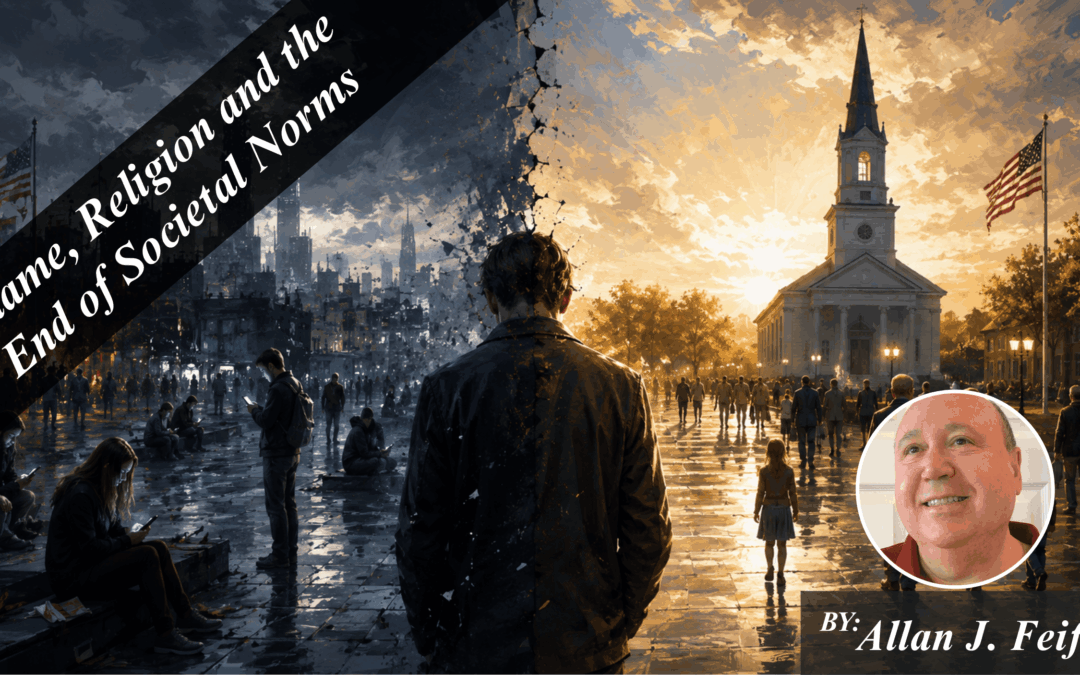
A perfect illustration of our cultural collapse is the growing trend of people not only committing crimes but also proudly filming themselves doing so on social media. In Queensland, police recently charged 90 young offenders under new “posting and boasting” laws after they recorded and uploaded their own car thefts and breakins to TikTok, treating criminal behavior as entertainment rather than disgrace. Offenders commit the crime specifically to post it, seeking online validation regardless of moral or social consequences. This is what a society bereft of shame looks like: bad behavior is no longer hidden in the shadows, but broadcast proudly, to garner clicks, the new currency of the realm. Multiply this by a million every day, and you get a sense of the scale of the malaise.
If I were the devil and wanted to undo the Creator’s perfect design, the first thing I’d eliminate is shame. Remove shame, and the rest collapses like so many dominoes. Without shame, belief in God becomes optional, then inconvenient, then irrelevant. And once God is dismissed, a vacuum opens that people rush to fill with either their own self importance—making themselves the center of the universe—or with the appetites of the ungodly: desire without duty, impulse without restraint, and a steady erosion of any standard that interferes with the latest craving. The Marxist destroyers understand this perfectly. The removal of shame is a primary tool, and it is dissolving the core of Western Civilization before our eyes.
America’s War on Moral Restraint:-
Millions now treat shame as some archaic, pseudo religious relic that restricts their “rights.” When man places himself at the center of the universe, he confuses ego for truth. It flatters our vanity to imagine the cosmos bending toward our desires, but in practice it breeds entitlement, shortsightedness, and an inability to accept being told “no.” A society built on delusional thinking corrodes from within. When every individual sees himself as the center of the universe, we lose an attachment to the larger picture—duty, community, reality itself. “Me” ends in destruction.
Shame, properly understood, is one of the essential engines of a healthy society. It reminds people that their actions don’t occur in a vacuum and that boundaries matter even in the absence of a law prohibiting such conduct. When shame disappears, so do the internal brakes that keep selfish impulses from overwhelming our shared norms that make community possible. Shame isn’t about cruelty or humiliation; it’s the subtle pressure that nudges people toward responsibility, restraint, and consideration for others. Remove that pressure, and the center of gravity shifts from “we” to “me,” and our social fabric dissolves.
Before 1970, shame operated as an invisible guardrail, and people felt it broadly. Divorce carried a stigma. Unwed pregnancy was handled quietly. Living off government assistance was seen as a temporary embarrassment, not a lifestyle. Even everyday conduct—how one dressed, how children behaved, how loudly personal problems were aired—was shaped by a shared understanding that certain conduct wasn’t acceptable. Those pressures weren’t always fair, but they created a culture in which people moderated themselves to avoid becoming the object of communal disapproval. That dynamic is nearly extinct today.
Today, society encourages people to speak before thinking, indulge every impulse, and treat boundaries—social, financial, moral—as obstacles to selfexpression. With no standards, there can be no judgment, a perfect recipe for societal rot. All of which leads to a society that is louder, ruder, and increasingly in decline.
And behind this unraveling, we find the usual suspects: a government that exists for its own perpetuation and Marxists masquerading as something softer and less threatening—progressives. How else to explain a society choosing to dismantle itself? The path they champion leads nowhere but ruin, and it is obvious to anyone willing to look.
The End of Natural Limits:-
For most of human history, poverty and starvation acted as natural constraints on the wackos. Those pressures kept people tethered to reality. Remove them, and you unleash millions of self actualized individuals convinced they can do whatever they want, believe whatever they want, and demand society accommodate their often fantastic predilections. They never grasp that they survive only on the resources and goodwill of the very civilization they despise. When that civilization collapses, they will be its first victims—starving, raging, and bewildered at the unfairness of it all.
I haven’t been a regular attendee of religious services since my Bar Mitzvah, but I retained the essential truths of a Judeo-Christian tradition: the importance of God, our place on Earth, loyalty to family, continuity, conservatism, patriotism, and the obligation to leave this world better than I found it. These tenets form the grounding a free society demands. Without them, we will be plundered into extinction by those believing in nothing but themselves.
Here’s a parable that captures why shame is not something to reject but something to cherish:
In a small town, a bell hung on a post in the center square. It wasn’t for emergencies; it was for accountability. When someone acted selfishly—cutting in line, cheating a neighbor, speaking cruelly—the townspeople didn’t punish them. They simply rang the bell once. No names were spoken, but everyone understood: someone had stepped outside the bounds that kept the town viable. Over generations, the bell rarely rang—not because people were perfect, but because the quiet possibility of hearing it restrained their worst impulses. When the bell was finally removed as an outdated relic, the town didn’t collapse overnight. It simply grew noisier, ruder, and less safe, until people realized the bell had never been about shame for its own sake. It had been the thin line between order and doing whatever one pleased.
Who among us wouldn’t welcome such a bell today? Who wouldn’t press a button that restored civility, respect for law and order, and basic propriety?
Conclusion:-
It’s been said that the devil’s greatest trick is convincing us he doesn’t exist. I’d argue an even greater trick is persuading us to dismantle the restraints that make civilization viable and self-sustaining, to tear down great institutions that once guided us, and to forget what a righteous life looks like. Without standards—without shame—we drift, rudderless, angry, gullible, and alone.
Bring back shame. Bring back standards. Bring back the expectation that we must live moral lives within a moral society. Does anyone truly believe we can survive another way?
 Allan J. Feifer—Patriot
Author, Businessman, Thinker, and Strategist. Read more about Allan, his background, and his ideas to create a better tomorrow at www.1plus1equals2.com. Read additional great writers here.

https://www.google.com/search?q=clayton+christensen+%26+marxist+chinese+student+comment+on+democracy&rlz=1C1GCEU_enUS875US875&oq=clayton+christensen+%26+marxist+chinese+student++comment+on+democracy&aqs=chrome..69i57.43150j0j15&sourceid=chrome&ie=UTF-8
https://www.longwoods.com/content/22212/insights/the-importance-of-asking-the-right-questions
https://www.youtube.com/watch?v=K6JYk5aCB4A