
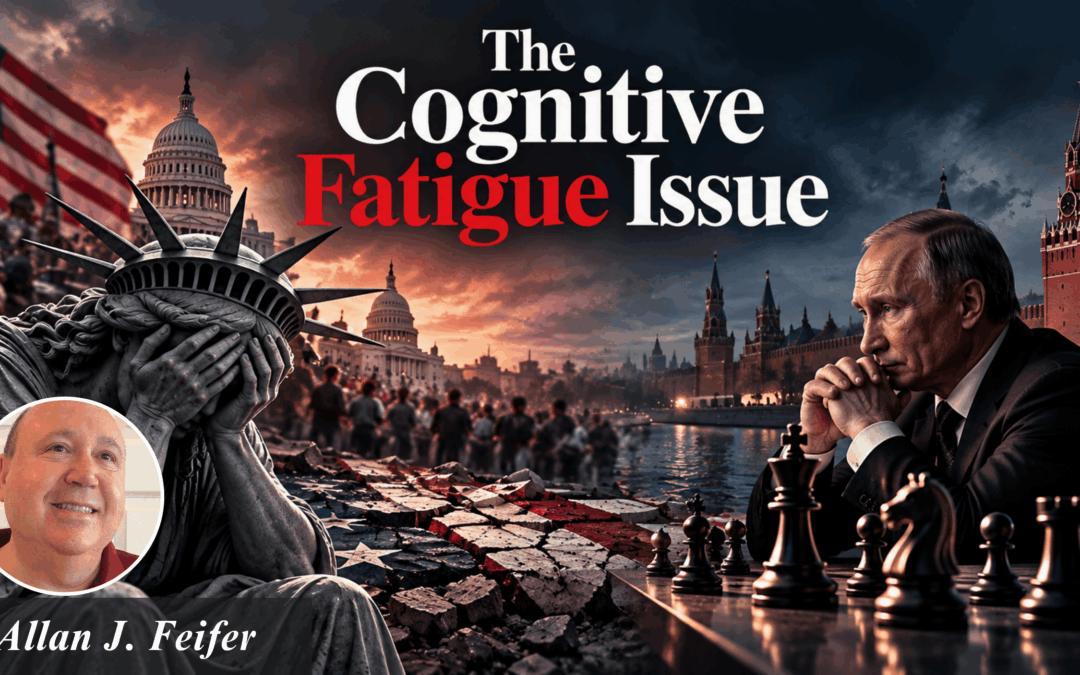
As it does periodically, the world will rebalance itself yet again. The last great rebalancing occurred after the Second World War, when the United States became the undisputed leader of the free world and the Soviet Union eventually reached the height of its influence before cratering spectacularly. Today, there are new usurpers claiming they are the future, principally China, Islam, and Russia. The U.S. won’t necessarily lose the mantle of leadership, but it is being severely challenged.
The U.S. has had a good run, but, like so many other dynasties before, it has lost much of its essential grounding and mojo, a victim of complacency and too much easy living. No country has a guaranteed or even implied “sell-by date.” Its longevity depends on how long it can maintain internal consistency by rejecting a big-tent mentality treating all ideas as equal; history amply demonstrates that’s false. History also reveals that when internal discipline dissipates, so do a country’s fortunes. We are at that moment today.
USA can fought Any Enemy:-
We’ll concentrate on Russia for the moment, but the same lessons can be applied to China and to Islam’s direct challenge to Western values and traditions, which threaten us as much as a frontal assault. The essential takeaway is that our country can face any number of enemies if we remain internally consistent with our values and traditions, and especially in the moral confidence that binds us together as a people. At present, a growing number of our citizens have lost, or are losing, that confidence that America is unique and special, and the best example of what a country should aspire to be, warts and all.
America and Russia are both suffering from what I term cognitive fatigue, though for different reasons:
Nations become cognitively fatigued when their collective ability to process complexity, maintain coherence, and act with discipline erodes. It’s not about weakness — it’s about overload revealed through:
Short attention spans, hyper-reactivity, belief in falsehoods, a forgotten or, worse, false institutional memory, lack of confidence that leads to paralysis, and distrust of our institutions.
Russia has an implicit advantage over us because a single person sets its course. Russia can act quickly because Putin does not have to negotiate with a legislature, the public, the bureaucracy, the courts, the political opposition, or allies before acting. Yet that apparent advantage has a cost: when information reaching the top is inaccurate, consequential errors and false assumptions accumulate.
The West uses its best features—open debate, legal restraint, institutional transparency, and constitutional checks and balances—to process information and make decisions. Those same features can make us painfully slow when speed matters. Since WWII, the U.S. has grown increasingly reactive, giving Mr. Putin more room to run before we catch up and apply our superior industrial and military resources, backed by the full weight of Western capabilities, to meet the challenge. Of course, that assumes we marshal the political will and fortitude to do so.
Unfortunately, we are suffering from all of the above effects of cognitive fatigue, painfully visible along our expanding fault lines. Russia is in the same boat, but much worse, as I’ll explain.
Russia’s ability to substantially expand its war effort in Ukraine is far more constrained than its rhetoric argues. Its manpower pool is already strained, the training pipeline is saturated, and the industrial base is running flat out. Every additional mobilization round produces diminishing returns: lower-quality recruits, more domestic resistance, and inevitable economic disruption. Equipment losses continue to outpace production, logistics are stretched thin, and the ruling class’s loyalty shows visible signs of crumbling.
In other words, Russia’s capacity to escalate militarily is eroding faster than its political willingness to escalate. Putin can announce new offensives, threaten new mobilizations, or saber-rattle once more, but the underlying system is increasingly hard-pressed to generate the combat power required to deliver on those threats. Its rhetoric increasingly exceeds its capacity.
This creates a strategic paradox that Western governments aren’t acknowledging openly. Ukrainian victory is desirable in principle, but many Western policymakers view a destabilized Russia as their nightmare scenario. An effective Russian defeat could trigger internal disarray, political infighting, or uncertainty concerning nuclear command and control—outcomes scarier than a stalemate. Thus, the West is caught between two imperatives: supporting Ukraine strongly enough to ensure it prevails, but not so dramatically or rapidly that Russia’s internal stability collapses.
America vs Russia Cognitive Fatigue:-
The uncomfortable truth is that an exhausted or cornered nuclear-armed Russia suffering increased instability is ultimately more frightening to Western policymakers than Ukraine winning.
America and Russia suffer from cognitive fatigue, but Russia’s version is deeper, more corrosive, and much harder for outsiders to observe. America’s fatigue is loud, visible, and self-diagnosing—expressed through open dissent, media scrutiny, and institutional transparency. By contrast, Putin’s Russia is concealed behind censorship, coercion, and a fake façade of control.
The Kremlin’s censorship restrictions mask the reality of its debacle: fractured leadership, worsening corruption, infighting, and a population increasingly at odds with the war’s stated purpose. What appears to be resolve from the outside is actually the product of state disinformation.
A strongman autocracy has great difficulty handling complexity or correcting its own mistakes because doing so risks ripping off the mask—something Putin cannot allow. Acknowledging failure threatens Putin’s safety. Russia’s fatigue is therefore far more advanced, more dangerous, and harder to reverse, even as the full extent of its failures remains hidden behind state-controlled narratives.
Russia’s one-man rule, often mistaken for strength, becomes a severe liability when the state is cognitively fatigued. A system that relies on one man to interpret reality, absorb complexity, and make fateful decisions eventually fails. Putin’s personal dominance blocks corrective feedback, suppresses dissent, and lets strategic mistakes compound instead of self-correcting.
By contrast, the West’s distributed leadership—messy, argumentative, and at times agonizingly slow—has the advantage. By creating multiple points where false assumptions can be challenged, corrective information and decisions follow more naturally. Democracies frequently stumble, but they also self-repair.
Historically, the West has a habit of arriving perennially late to the challenge but arriving decisively, with coordinated industrial, military, and political power that authoritarian systems can’t match. Our pluralism can be mistaken for weakness, while the danger remains ambiguous. But once danger becomes undeniable, our institutions align, our alliances activate, and our strategic response emerges—often at the last moment.
That may be the most important difference between American and Russian cognitive fatigue. Russia can conceal its fatigue because one man controls the narrative. America cannot. Our disorder is visible precisely because our system permits disagreement, criticism, and competing interpretations of reality.
Conclusion:-
The question is whether we can retain enough confidence in ourselves, our institutions, and the principles that created our success to recognize the danger—and act on it—before cognitive fatigue becomes something difficult to reverse. If we cannot, the next great rebalancing may not simply mark the end of American dominance. It may mark America’s most avoidable catastrophe.
God Bless America.
 Allan J. Feifer—Patriot
Author, Businessman, Thinker, and Strategist. Read more about Allan, his background, and his ideas to create a better tomorrow at www.1plus1equals2.com. Read additional great writers here.

Recent Comments