
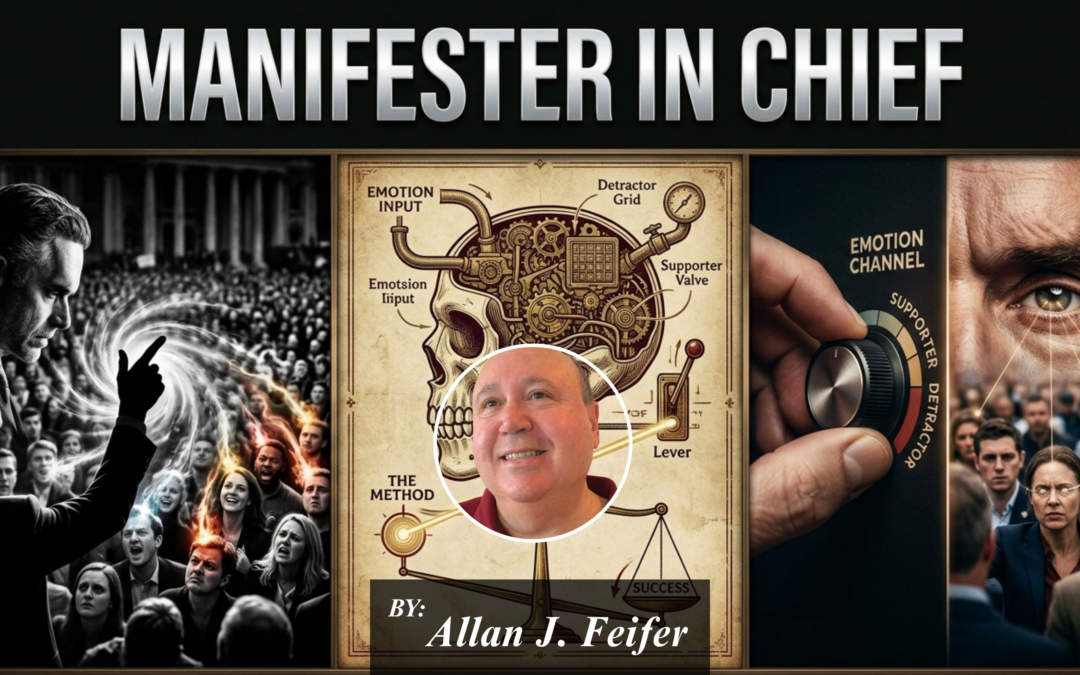
Trump Derangement Syndrome—TDS—is widely mischaracterized, to the point that many people now treat it as if it were an actual diagnosis from the DSM‑5, the standard manual for mental disorders. It isn’t. Yet the phenomenon is real enough that millions of otherwise ordinary people react to Donald Trump with a level of intensity wildly disproportionate to whatever he has just said or done. Few, however, have explained the mechanism that produces those reactions. Let’s take a shot at identifying it.
The usual framing—Why do so many people hate Donald Trump?—turns out to be the wrong question. A better one is: What is it about Donald Trump that makes people reveal themselves, frequently explosively? If we can answer that, maybe some last-minute course tweaks could improve our odds of reaching people who have been resistant to previous persuasion attempts.
Why Every Trump Word Sparks a Reaction:-
Plenty of politicians are polarizing. Many are disliked. But none in modern American politics have become objects of such extraordinary fascination, fear, devotion, or hostility that every word they utter is filtered through such a deeply emotional lens. Trump’s rhetorical patterns are remarkably consistent; the reactions to them are anything but. The same comment can amuse one person, enrage another, frighten a third, and convince a fourth that he is exactly the leader the moment requires. That divergence suggests that Trump is not simply generating political emotion—he is manifesting it. I can’t remember any other politician in my lifetime who possessed that capacity.
To understand this, we need to understand the lens through which Trump himself operates. His worldview is built around dominance rather than consensus, using outrage as a strategic tool. He has an unusually high tolerance for risk and conflict, responding to threats by escalating rather than de-escalating. He interprets emotional reactions as proof of effectiveness, possessing a performer’s instinct for audience psychology. None of this is accidental. Conflict attracts attention; attention aligns identity; identity consolidates power. Rage is not his objective, but he understands that rage fuels the cycle he depends on to dominate the opposition.
This is why TDS is distinct from mere political dislike. If Trump were merely obnoxious, the reaction to him would be proportional to whatever obnoxious thing he had just done. Instead, people who have already concluded that Trump is dangerous interpret virtually everything he does as proof of that danger. Those who believe he is dishonest see it in everything he says. Those who fear authoritarianism interpret even routine political behavior they would accept with their own favored candidate as a threat to democracy when it is associated with Trump.
These reactions become self-reinforcing. Trump acts; his opponents interpret the action through their TDS lens; the emotional response strengthens their preexisting beliefs; subsequent actions tighten the spiral. Eventually, the original event becomes irrelevant. This explains one of the strangest characteristics of TDS: its resistance to contrary evidence. A concession becomes proof of weakness while a victory becomes proof of danger. Restraint is inferred to be calculated; any aggressiveness must be instability. It all becomes a predictable devolution: watching someone shut down in the face of a logical argument, no matter how well presented.
This is how Trump becomes a manifester. He doesn’t simply provoke reactions—he exposes individual beliefs, fears, priorities, and assumptions already present. Trump is unusually willing to challenge political conventions, institutions, and boundaries that politicians instinctively avoid. His willingness to violate political conventions reveals how much people have come to rely on them. His willingness to confront institutions reveals how much people trust or distrust them. His attacks on political opponents reveal whether people see political disagreement as legitimate competition or Trump as an existential threat. Trump is their political Rorschach test.
But there is another dimension to this phenomenon, one with serious implications, because our adversaries can see it too. Foreign governments, including Iran, have long exploited divisions inside the United States. They do not need to defeat America militarily to influence American politics; they only need to deepen distrust, amplify anger, and magnify discord. With conflict in the Middle East affecting global energy markets and domestic economic pressures rising, the emotional volatility surrounding Trump becomes a strategic vulnerability. Iran can provoke him, while the media reflexively magnifies the conflict, leading Americans to react to the noise rather than any underlying strategic reality. The feedback loop becomes self-sustaining. It’s actually quite dangerous because it’s a key vulnerability inherent to our system and a danger to our core interests.
Trump’s Combativeness Meets Its Match:-
This creates a peculiar challenge for Trump. The very characteristics that made him extraordinarily effective in political combat can become liabilities when dealing with an adversary who understands his psychology better than most Americans do. If provocation produces predictable escalation, and escalation produces domestic division, then Trump’s strengths can be turned against him, and by extension, the American people.
The Iran standoff has also left Trump without the kind of clear win he promised, while its economic consequences threaten Republican candidates at the worst possible time. Iran doesn’t have to defeat America militarily to influence the November election. It only has to help Americans become sufficiently angry, frightened, divided, and economically frustrated that they turn against the party in power, thereby doing the enemies’ bidding.
Which means Trump now has an opportunity to demonstrate something that may be more politically valuable than another victory over an opponent: self-control.
He cannot change who he is—and he shouldn’t try. But he can decide what he manifests. If opponents expect chaos, he can manifest control. If they expect escalation, he can manifest strategic patience. If they expect another personal confrontation, he can decline to engage. And if foreign adversaries are deliberately trying to provoke an American political reaction, refusing to play their game becomes a form of strategic warfare in its own right.
The same principle applies domestically. Trump does not need to convert the hardcore of his opposition. He needs to make enough reluctant Republicans, independents, and middle-of-the-road voters feel comfortable voting Republican. Lower prices, economic growth, secure borders, and tangible improvements in people’s lives speak louder than another round of Trump versus the world. Americans must see this as his focus.
Conclusion:-
If Trump truly is a manifester, this moment offers a rare opportunity. He cannot control what people see in him, but he can control what he gives them to see. The man who mastered political combat may now have to demonstrate mastery of something even harder: knowing when not to fight.
God Bless America.
 Allan J. Feifer—Patriot
Author, Businessman, Thinker, and Strategist. Read more about Allan, his background, and his ideas to create a better tomorrow at www.1plus1equals2.com. Read additional great writers here.

The only effn time that President Trump is required to stop
fighting, is when the current Communist/un-Democrat effn Party;
our American radical Blacks and radical Muslims have effn disap-
peared, and their effn name have been attached to the effn
obituary columns, at least in the United States. Better yet, the
current presidential title assigned to President Trump, must be
changed to King Trump, so that he can assume total control of
American politics, and not be interferred with the effn whims of
the worthless Communist/Democrat Party, when their effn names
have been attached to the American obituary columns.
Cheewiz Dennis: I think you had too much cafeine this morning! (g) I love Trump, but I also love our system. I’m a believer we’ll find a way to keep Trumpism alive even after he’s departed the scene. I don’t know how, but I’m not willing to cede the field to the anti-American crowd. Not today, not ever.
Thank you for your comment: Allan
A subtle and trenchant analysis of “the Trump phenomenon” as a whole. The point about an “externality” in the form of hostile foreign powers making use of Trump’s unmasking of otherwise less visible domestic divisions is well taken.
Very nice analysis.
In his book on the pandemic response, Dr. Scott Atlas noted this behavior of Trump’s, how he would ask for the names of the reporters who were going to go on the offensive and call on them first; he did not shrink from the fray, he waded right into it.
Very refreshing to see a patriot offer constructive criticism based on something Trump is actually doing.
BTW I was led to this site through one of your articles in American Thinker, on Russia. I think that the war in Ukraine is another area where Trump’s typical methods are failing him, because he does not understand the true nature of the conflict. I hope and pray that maybe he is beginning to get some good advice there, at last.
Good Morning, Ben: President Trump is an enigma, even to me. I don’t have access to all the competing priorities that the leader of the free world must address with admittedly finite resources. Trump is brilliant, but does not have an unlimited span of control, no one does. I personally view the Ukrainian war as an existential check on Putin’s power.
In an upcoming article, I’m going to digest what the world would look like today, if we had sat out WWII. Hint: We’d be speaking German.
Thank you for your comment.
Allan