
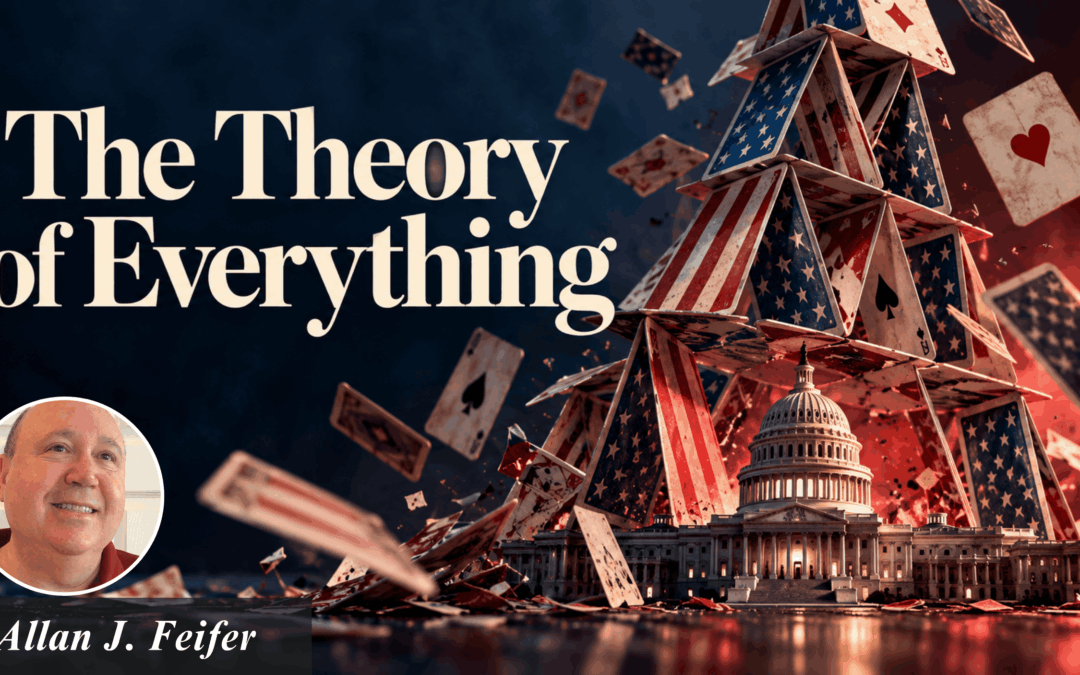
Something dangerous is happening in America, and it may stem from a single causal nexus. Every day, more Americans seem to decide what they believe based on political signals rather than factual reality. The economy, inflation, affordability, foreign threats, gas prices, institutional performance—all shape our sense of direction. When enough signals turn negative at once, voters demand change, even when the “solution” may be worse than the disease.
Like a wobbly house of cards, Americans are witnessing an extraordinary breakdown of trust both in their government and society. Whether on the right or the left, fear, anger, and a resignation that America may be failing dominate what passes for a national conversation.
There’s ample room for concern. We have problems. But something else may matter even more: our perception of America increasingly bears little relation to the country’s condition, leading to an uncomfortable question: What if America is doing considerably better than average Americans think, yet they vote based on what they perceive rather than what actually is?
I’ve lived through the Vietnam peace movement, the assassination of Martin Luther King, the Cuban Missile Crisis, the Watts riots, the 1968 Democratic National Convention violence, the Oklahoma City bombing. Yet I have never seen Americans so disconnected from cause-and-effect relationships.
Three forces drive that disconnect.
The Collapse of a Shared Reality:
Americans consume different information, from different sources, and interpret it through different ideological filters. We don’t simply disagree about what to do; we disagree about what we see and hear, even what it means.
One side sees economic opportunity where the other sees economic exploitation. One sees institutional stability where the other side sees institutional corruption. One side sees America’s continuing global strength; the other sees national collapse.
When no one agrees on a starting point, or the gap between us is too large, disagreement becomes almost impossible to resolve.
The Weakening of a Shared National Identity:
America has never been culturally uniform. We continually argue about race, religion, class, immigration, economics, and the proper role of government. But disagreement once existed within a larger context: we were arguing about the same country’s future. An ever smaller pool of people has the mental wherewithal to discuss matters of vital and consequential interest rationally.
Americans are encouraged to define themselves by political, cultural, and ideological affiliations as superior to their identity as Americans. As a result, disagreeing with another American becomes disagreeing with America itself. Our political identities increasingly determine not only what we believe, but what we accept as truth.
The Fight Over Institutional Legitimacy:
Government, courts, media, universities, corporations, elections, and other institutions are increasingly judged by their politics rather than their traditional responsibilities. Politics has become a contagion that hyper-emotionalizes every issue.
When people trust an institution only when it produces the outcome they want, legitimacy becomes conditional. And once legitimacy becomes conditional, every institutional decision becomes another piece of evidence in a self-reinforcing argument that the system itself is fatally flawed.
Three forces interact and become dominant: A disputed fact breaks trust. Broken trust weakens essential institutions. Weak institutions reinforce competing versions of reality. Competing realities then weaken national identity. The weakened identity amplifies institutional disagreements.
The result is a feedback loop in which every problem becomes evidence of every other problem, creating a self-reinforcing narrative—try arguing against that with people who only know what they’ve been indoctrinated with!
No conspiracy is required to produce it. Competing political interests, fragmented media, social-media algorithms, institutional distrust, and ideological polarization can accomplish the same thing without anyone directing the process.
And yet another America too few see and appreciate exists
Take a moment and look at what is going well.
The Census Bureau’s latest data show real median household income reached its highest level in history in 2025. The Atlanta Fed’s GDPNow model is estimating 5.1% annualized GDP growth for the third quarter. The official poverty rate has fallen to 10.2%, the lowest level on record. American innovation has not stopped. The United States remains a global leader in research, high-technology industries, venture capital, and the commercialization of new technologies. Is this generally known and believed? I don’t think so.
Contrary to what many are told or believe, America remains a capable great power, militarily and economically. Our alliances span the globe, the dollar remains central to the international financial system, and American companies remain deeply embedded in the world’s most important technologies and markets.
America is not a failing country, contrary to general belief. That truth is getting lost, in part because it is politically advantageous for some to portray America as something it isn’t. Inflation matters. Affordability matters. Government dysfunction matters. Political polarization matters. Social disorder matters. Foreign threats matter. But possessing problems and then jumping to collapse is frankly dangerous. Somehow we have allowed the existence of problems to become evidence that everything is a harbinger of doom.
That may be the real “theory of everything”: that problems equal generalized failure.
Every negative story receives amplification. Every institutional failure becomes another reason for distrust. Every political victory by the other side becomes evidence that America is moving in the wrong direction. Meanwhile, good news falls flat. Even a family experiencing higher real income doesn’t necessarily feel that the country is thriving. A technological breakthrough doesn’t make inflation disappear. America’s military strength doesn’t make a political disagreement less bitter when gas prices keep climbing, or an unpopular but necessary military action remains unresolved. And, oh, those pesky gas prices!
The human mind is wonderful at connecting negative events. Eventually the connections become the story, or worse, reality. America is struggling; therefore America is declining. America is divided; therefore America is broken. Government has failed; therefore the system has failed. The system has failed; therefore something entirely different is required to replace it.
That last step is where our enemies waiting in the wings enter the picture and can do the most harm. A population that believes its country is fundamentally broken becomes receptive to solutions appropriate for a country that actually is broken. Those solutions can sound compelling precisely because they promise to explain everything.
But America is not one thing. It is an economy, a culture, a constitutional system, a military, a scientific enterprise, millions of businesses, hundreds of millions of individuals, and an accumulation of human capital and productive capacity earned through effort and often by failure. It can be badly governed without being incapable. It can be divided without being doomed. It can be frustrated without being finished. The challenge is to recognize what is genuinely broken without convincing ourselves that everything is broken.
Perhaps America doesn’t need another theory explaining why everything is going wrong.
Perhaps it needs something harder: the discipline to distinguish what is failing, what needs reform, and what is working well. That requires perspective. And America is sorely low on perspective.
God Bless America.
 Allan J. Feifer—Patriot
Author, Businessman, Thinker, and Strategist. Read more about Allan, his background, and his ideas to create a better tomorrow at www.1plus1equals2.com. Read additional great writers here.

Recent Comments